The Construction Markup Stage lets you draw dedicated linework on separate layers, making it easier to edit, print plans, and apply global settings to specific layer types.
Use it to add guides, plumbing and electrical runs, callouts, and custom line styles. You can also draw and edit new shapes with the line, arc, and other drawing tools.
Markup Overview Video 🎥
Complete and incomplete shapes may be drawn in the Construction Markup Stage, but they will never appear in 3D.
Shapes from Design Stages may not be edited, though their line style may be changed under Object Styles and hidden by using Hide/Unhide.
Construction Markup Defaults
The line style, line color, fill pattern and fill pattern color of any shape may be set in the Construction Markup Stage.
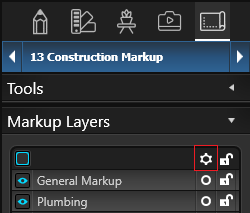 The Gear icon at the top right of the layer list, allows you to set default font, fill styles, line styles, colors and categories.
When you press the Gear Icon, the Default Markup Layers dialog will come up. The settings you select will apply to all new lines and shapes drawn on the layer and in future projects.
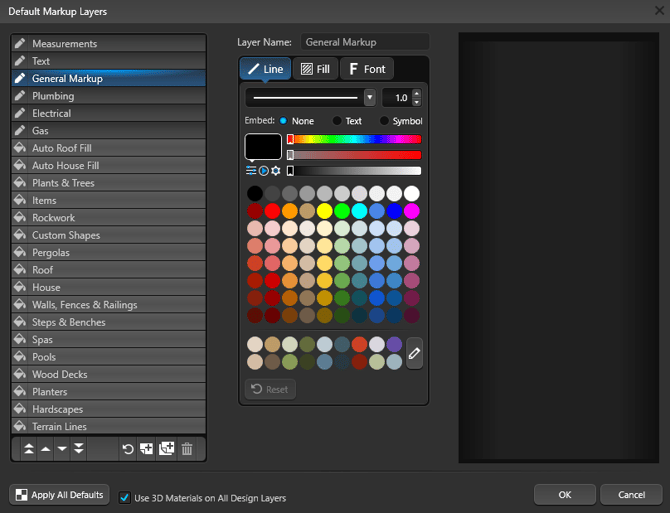
You will also set your default Text Font and Measurement Font on this dialog.
By setting the font size and style for both the Measurements and Text layers, you will establish your preferred settings as the default.
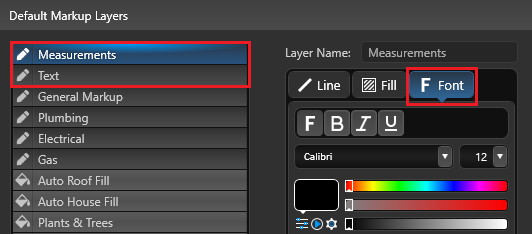
Apply All Defaults: Use this option to apply all of your saved default settings to the current project.
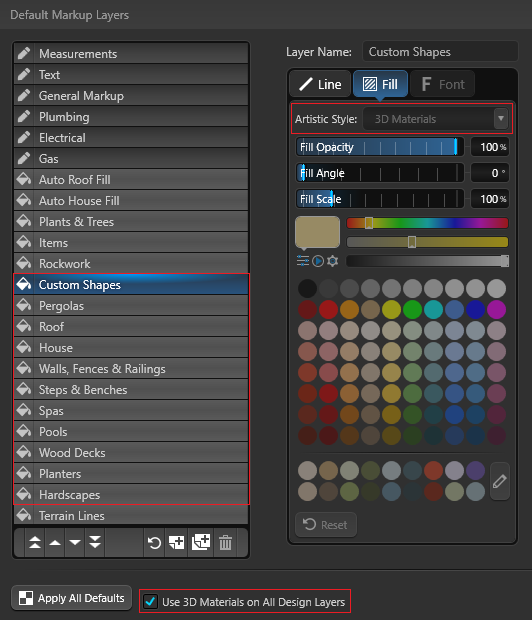
Use 3D Materials on All Design Layers: Check this option to set 3D materials as the default fill style for all Stage Layers, uncheck the option to set a custom default fill style.
Construction Markup Layers
You can easily Hide and Unhide specific layers and all objects or lines contained within that layer by clicking directly on the Blue Eye, Blue box or empty box.
The buttons located at the bottom of the Markup Layers allow you to create a new layer, duplicate an existing layer and remove an existing layer.
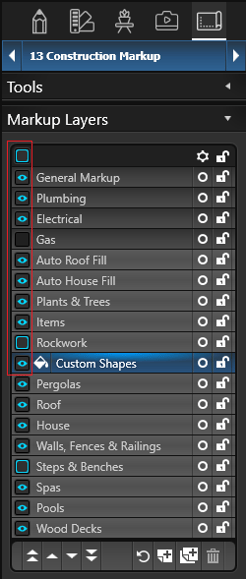 Pencil or Paint Bucket: This icon will appear next to the Markup layer you are currently editing, the active layer.
Any new lines or objects added to the 2D Viewport will be assigned to your active layer.
If you need to move a line or object from one layer to another, copy it (Ctrl+C) click on the desired layer and paste (Ctrl+V).
A layer must be active to edit it.
Blue Eye: This icon will appear next to visible layers. A layer must be visible to edit it.
Blank Square: This will appear next to hidden layers. When a layer is active, hidden objects and items on that layer will appear in purple. When that layer is no longer selected, the contents remain hidden.
Blue Box: This icon will appear next to layers on which some objects and/or items are hidden.
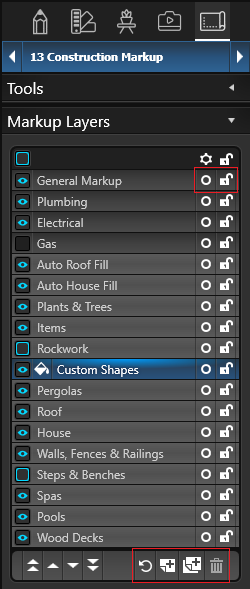
O: This icon to the right of the layer name will quickly select everything on that layer.
Lock: This icon to the right of each layer signifies if the layer is editable. An open lock signifies the layer can be edited. A closed lock signifies the layer cannot be edited and nothing on the layer can be selected.
It’s a good practice to lock layers as you complete work on them to avoid mistakes.
Restore: Restore default layer order.
Create New Layer: Create a new Markup Layer. You will be asked to name the new layer. Once the layer has been named, press OK to add it.
Duplicate Existing Layer: Copy the currently selected layer. You will be asked to name the copied layer. Once the layer has been named, press OK to add it.
Delete Existing Layer: Remove the currently selected layer.
Set Layer Defaults
Double-click a layer in the Markup Layers list to set that layer’s default fill, line styles, and colors.
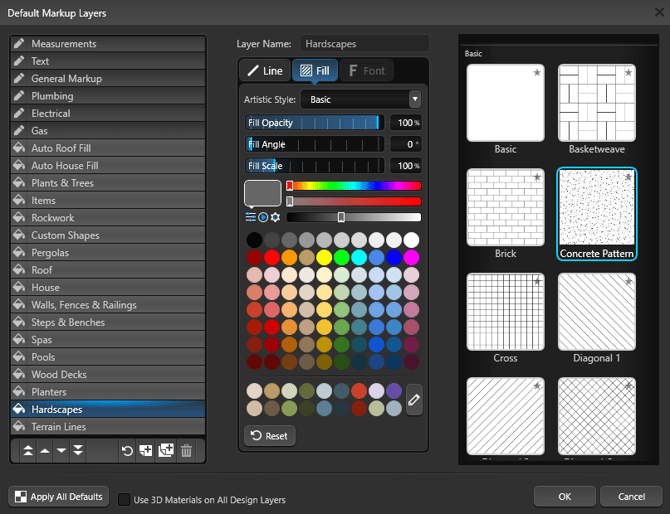
Default Fill Style: Choose an Artistic Style from the drop-down menu and a fill pattern from the library to set the layer’s default fill. To use no fill pattern, select None.
Default Fill Pattern Color: After selecting a fill pattern, set its color with the Color Sliders or Swatches. Note: Only Basic fill styles can be edited. Click Reset to revert any color changes made with the sliders or swatches.
Default Line Style: Define the default line appearance by selecting a line style from the drop-down menu. To use no line style, select None.
Default Line Color: After choosing a default line style, set the line color using the Color Sliders or Swatches.
3D Materials on All Layers
When this option is enabled and 3D materials are set as the default fill style for every Design Layer, the controls for applying a custom fill are grayed out.
Clear this option to set your own default fill style instead.
Visual Stacks
How objects and lines are stacked determines how they will display when they overlap. In Design Stages, you can select an object that is hidden underneath another object. In the Construction Markup Stage, you can only select the top most object or line.
If you are unable to select an object or line because it is below another, you must select the top object or line and move it below the object or line you want. You can change the stacking order of objects and lines by typing in a new number or pressing one of the four Stack buttons in the Panel.
Object Settings: With an object selected, stack controls will appear under Object Settings. This shows the selected object’s stack order on the active layer. For example, if a House is selected, this is the selected object’s order among all House shapes.
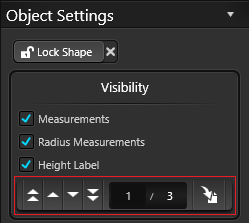 Double Up Arrows: Move selected object or line to top of visual stack.
Up Arrow: Move selected object or line up one position in visual stack.
Down Arrow: Move selected object or line down one position in the visual stack.
Double Down Arrow: Move selected object or line to bottom of visual stack.
Change Stack Order: Type in a new value in the first field or use one of the four stack buttons.
Move to New Layer
Use the Move to New Layer button to move selected shapes and objects from any layer to create custom layers.
First, select the design shapes or objects you would like to move. Next, click the Move to New Layer button.
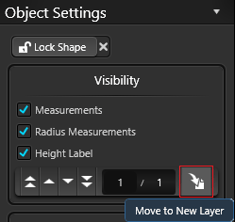 From the drop-down menu, select Move to New Layer and enter a name for the new Layer, such as Existing Hardscapes or Existing Plants.
Move to New Layer: Move selected shapes and objects to a new custom layer.
Move to Original Layer: Return selected shapes and objects back to the original layer.
Add Measurements
New measurement lines may be added to Markup Layers in the 2D Viewport by using the Measure Tool located under Tools in the Panel.
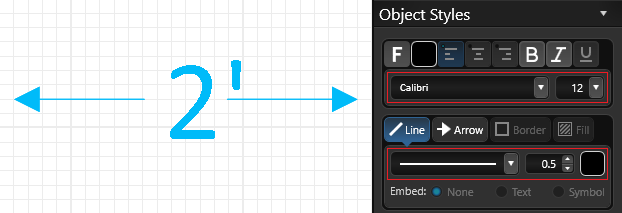
Font: The measurement text font and font size may be changed on the Text/Font tab.
Line Style and Size: Different line styles for the measure tool may be selected from the Line Style drop down box under the Line Styles Tab.
Line Color: The line color may be changed by single left clicking the Color Square.
Arrow Style and Size: The arrow style and size may be changed by selecting a different arrow style from the drop-down menu and setting the size.
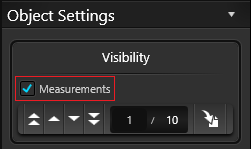 Display Measurement Text: To show the measurement line text, check the Measurements box under Object Settings. To hide the measurement line text, uncheck the box.
Shape Measurements
By default, shapes do not display measurements. You can control measurement settings in the Panel under Object Settings.
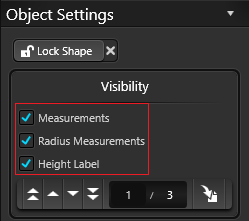 Measurements: To show measurements on any selected shape, complete or incomplete, check the Measurements box. Clear the box to hide them.
Radius Measurements: To show radius measurements for any selected shape, check the Radius Measurements box. Clear the box to hide them.
Height Label: To show the height label in both 2D view and Construction, check the Height Label box.
Text
Add text to Markup Layers with the Text tool under Tools in the Panel. Edit any text you create or insert from the Library by double-clicking it.
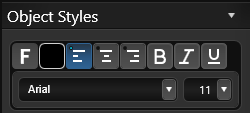
Font: The text font and font size may be changed by single left clicking the Font button.
Text Color: The text color may be changed by single left clicking the Color Square located to the right of the Font button.
Align Tools: By default, text will align left. Text may be aligned left, center or right by left-clicking one of the Align button.
U: The text may be underlined by single left clicking the U button.
Callout Arrow: Select Add to attach an arrow to the text. Use the Move tool to position the arrow so it points to any location in the viewport. Adjust the center point of the arrow to bend it as needed. You can add multiple callout arrows to a single text box.

Callout Arrow Style and Size: Change the callout arrow style by choosing a different option from the drop-down menu, then set the desired arrow size.
Label Text: Selecting label text will create form style text with lines for information. The information label will appear on the left and lines for information will appear to the right. Double-click Label to enter your own label. Double-click the first line to type information. Press Enter to move to the next line.
Label Underline: Selecting label underline will add or remove the underline to the right of the label text.

Line, Arrow & Border Options
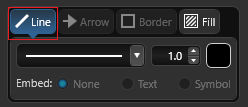
Change Line Style: Choose a different line style from the drop-down menu.
Change Line Color: Click the Color Square to set a new line color.
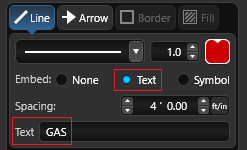 Embed Text: Turn on Embed Text to place text directly along a markup line, then enter the word or phrase you want to repeat on that line. Next, set the spacing value to control the distance between each repeated word or phrase.
Embed Text is available only on Markup layers. It cannot be used on Design layers.
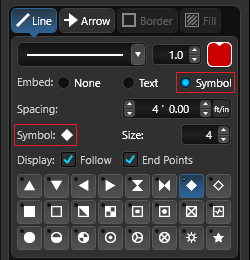
Embed Symbol: Turn on Symbol to place a symbol along a markup line, then choose which symbol to use and set its size.
Next, set the spacing value to control the distance between each repeated symbol.
Enable Follow to have the symbols align with the direction of the line.
Enable End Points to place symbols at the start and end of the line.
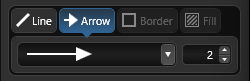 Arrow Style and Size: The arrow style and size may be changed by selecting a different arrow style from the drop-down menu and setting the size.
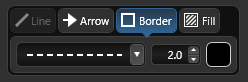 Border Style and Size: The border style and size may be changed by selecting a different border style from the drop-down menu and setting the size.
Fill Pattern of Selected Shape
Select a new fill pattern from the Fill Patterns category in the Construction Library. The List View will show available patterns, and the Thumbnails panel will display a preview of the selected pattern.
Apply Fill Pattern: To apply a fill pattern, double-click its name or preview image, or use the Insert buttons.
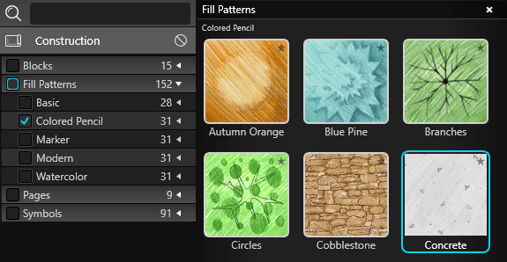
Adjust the fill style, fill color, line style, and line color for any selected line or shape in the Panel under Object Styles.
Fill Options
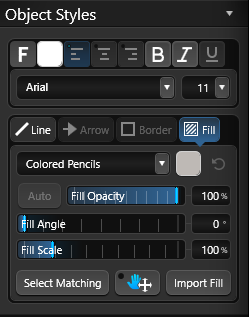 Change Fill Style: Select a different Artistic Style from the drop-down menu under the Fill tab in the Panel.
Change Fill Opacity, Angle, and Scale: Adjust the fill pattern opacity, angle, and scale using the sliders.
Change Fill Pattern Color: Click the Color Square to set a new color for the fill pattern.
Select Matching: Click this button to select every shape that uses the currently selected fill pattern, so you can quickly edit or replace multiple shapes at once.
Import Fill
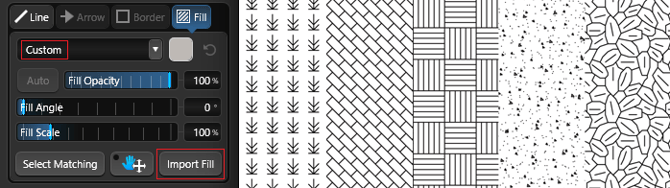
With the Import Fill option, you can import images to create your own custom fill patterns. You can even save these fill patterns to your Library to use in future projects.
Special Rulers
To measure an object like a freeform pool, for example, simply select the pool and click the Triangulation Ruler or the Centerline Ruler button.
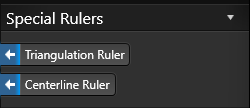
A new Markup Layer will be generated instantly — complete with your measurement lines and a green border outlining your selected shape — ready for you to edit, adjust, and print.
For details see Triangulation and Centerline.
Object Modification
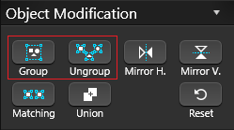 Group: Selected lines or objects will be grouped together. These lines or objects will now behave as a single object. Grouping lines or objects will make them easier to move around and keep organized.
Ungroup: A selected group will be broken back into individual objects. If the group is composed of smaller groups it will be broken back into the smaller groups.
These once grouped objects will now be individual objects. If an object has a fill pattern and is ungrouped, the fill pattern will be lost.
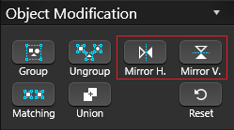 Mirror Horizontally: The selected object will be mirrored horizontally.
Mirror Vertically: The selected object will be mirrored vertically.
NOTE: Only objects on Markup Layers can be Grouped, Ungrouped or Mirrored.
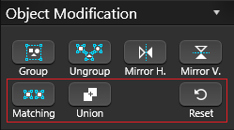 Matching: Pressing this button will select all objects in the design that match the currently selected object.
Union: Selected overlapping shapes will be joined together. The shapes will become a single shape.
Reset: Pressing this button will reset an object that has been rotated/ scaled. This will undo all changes and set the object back to default.
Label Guide
The Label guide allows you to move measurements in your plan. Left click and hold on a measurement and you can drag it along the line or pull it away with a callout line.
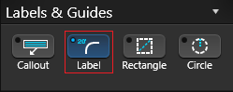
You can change the label font and size or hide the label under the Hide/Unhide menu.
Font: Pick Font allows you to change the font and size of the label text.
Text Color: The text color may be changed by single left clicking the Color Square located to the right of the Font button.
Hide/Unhide: Clicking the Hide Selected button in the Hide/Unhide menu will hide the selected label.
Create & Save Symbols
Create new symbols by using the Line, Arc, and other drawing tools to build complete or incomplete shapes. You can then reuse these symbols in your construction plans and assign them to library items, including plants and trees.
Use the buttons at the bottom of the Library to save, edit, or delete custom symbols.
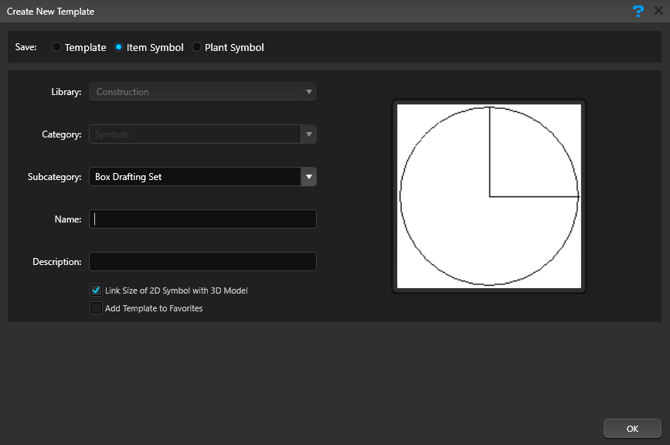
Save to Library: With your custom symbol selected, click Save to Library. The Create New Template dialog will open and show a preview of the symbol.
In this dialog, be sure to choose the correct Symbol Type:
- Click Template to save it as a symbol for use in Construction Markup or Page Layout.
-
Click Item Symbol or Plant Symbol to save it as the corresponding symbol type.
Add Symbols from the Library
You can add symbols from the Construction Library to the 2D Viewport on any Markup Layer.
In the Library, select the Symbols category. The List View will display available symbol templates, and the Thumbnails panel will show a preview of the selected symbol.
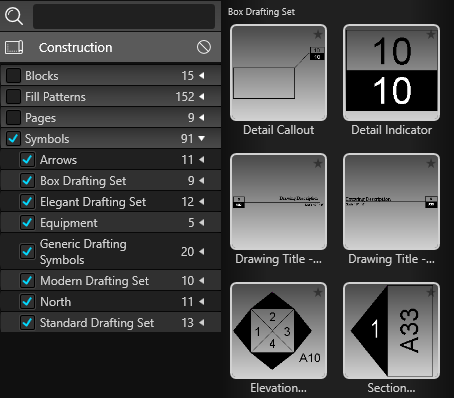
Insert a symbol by double-clicking its name or preview image, or by using the Insert One or Insert buttons.
Surveys & Plot Plans as Background Images
Insert background images in Stage 1: Project Information.
Any background image you added in earlier stages will also display in the Construction Markup Stage, keeping the exact scale you originally set.
This is especially helpful when a survey or plot plan must appear on your construction plan to meet permit requirements. For more information, see Background Images.
Print in Construction
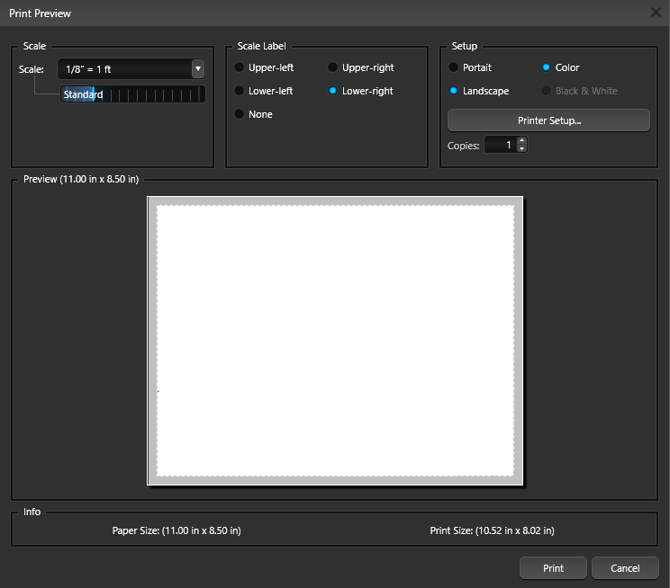
Selecting Print from the Application Menu will bring up the Print Preview box showing the current view of the selected page.
From the print preview box you may choose Print to complete your printing or Printer Setup to change printer options such as paper size and orientation.
Export in Construction
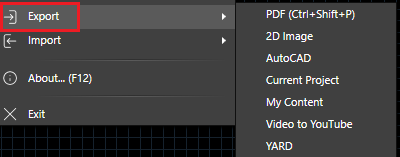
Selecting Export from the Application Menu will bring up the Export Options.
PDF: This option enables you to save the 2D view of your design in a format called .dxf, which can be easily opened using AutoCAD software.
AutoCAD: This option enables you to save the 2D view of your design in a format called .dxf, which can be easily opened using AutoCAD software.
2D Image: This option lets you export the 2D view of your design as a .png image file. PNG is a widely supported format that can be easily viewed and printed on virtually any computer.
Use this option to quickly share a 2D plan of your design with customers or send print-ready files to your print shop.