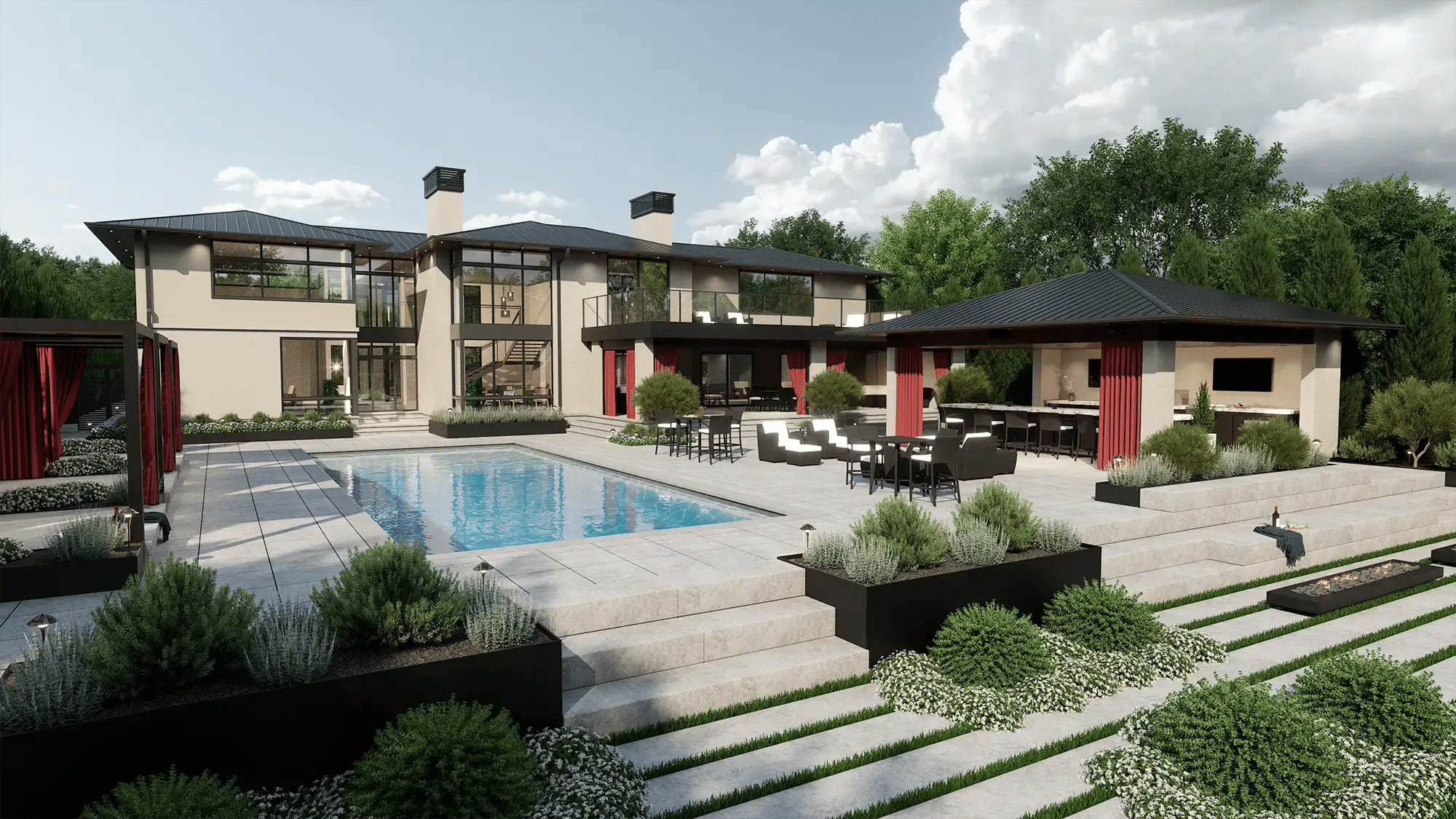




AI pool apps make a great-looking picture in seconds. The trouble starts when someone has to build the pool in it.
The image shows the look your client wants, but nothing in it is measured, so there's no depth or distance to the property line to work from. That part still takes a measured design in pool design software.
The good news is that the two tools work well together, with the AI image setting the style and pool design software making it buildable.
The trick is knowing where one stops, and the other takes over.
Key Takeaways
- AI apps are built for the style conversation. They turn a property photo into an inspiration image in seconds, before anyone has measured the site.
- An AI pool image carries no measurements. It can't tell you how deep the pool is or how far it sits from the property line.
- Asking for one change usually brings back a new pool. The app generates a whole new picture, and the pool in it often changes too.
- Pool design software keeps one measured design. In Pool Studio, every change updates the same design you use for presentations, material calculations, and build-ready construction plans.
- The client's AI image makes a good brief. Ask what drew them to it, keep those details, and design the real pool around them.
Quick answer: AI app or pool design software?
Each tool fits a different stage of the project.
|
How do AI pool design apps compare to pool design software?
An AI image and a measured design can look alike on screen. They start to differ as soon as the client asks for a change or whoever builds the pool asks for a number.
|
Question |
AI Pool Design Apps |
Professional Pool Design Software |
|
Where does it start? |
A photo of the property and a style choice |
The client's parcel, house, and measured site |
|
Does it have dimensions? |
No; the pool size is implied by the picture |
Yes; every shape is dimensioned |
|
What about depth, steps, and benches? |
Suggested visually, if at all |
Modeled, with volume calculated from them |
|
Can you change one thing? |
Usually by generating a new image |
Yes; the rest of the design stays put |
|
Are the products real? |
Generic materials and features |
Real spas, water features, and shells from a library, plus your own materials |
|
What do you produce? |
Images |
Presentations, material calculations, and build-ready construction plans |
|
How fast is it? |
Seconds to an hour |
Longer, because you're designing the real pool |
|
What does it cost? |
Free to a small one-time fee |
A monthly or annual Membership |
What AI pool design apps do well
AI apps are fast and cheap. GenRoom's pool tool promises a pool in a photo of the property in about 30 seconds, free and with no sign-up, and Pool Planner AI's G2 listing shows more than 70 images across five pool styles for a one-time $15 (as of 2026).
That speed helps most in the first conversation, when the client is still choosing between a lagoon feel and a clean rectangle.
Ten looks in ten minutes can settle a question that would otherwise take a whole meeting.
Architects and designers report the same thing. In the 2026 AI survey by Chaos and Architizer, which covered nearly 800 of them, 43% said AI helps most at the concept stage, and 85% of AI users said it saves them time.
The same survey found that 48% of respondents see unreliable or inconsistent results as their biggest obstacle.
For pool work, that puts AI at its best early on and least dependable once the decisions come down to measurements.
-1.png?width=512&height=341&name=unnamed%20(3)-1.png)
What an AI pool image leaves out
An AI image is made to look right from one camera angle, so the things you'd measure on site never make it into the picture.
1. The pool in an AI image has no measurements
The pool looks right for the space, but there's no length or width, and no distance to the house or the property line. Camera angle alone can make the same pool look much bigger or smaller than the space allows.
2. Asking for one change brings back a new image
Ask an AI app for a wider deck or a spa on the other side, and you usually get a whole new picture back. The new version often changes the pool's shape, and sometimes even the house.
3. The image can't show how deep the pool is
You see a blue surface, sometimes with steps sketched in. The image can't tell you how deep the pool or the tanning ledge is, and those depths decide how the pool gets used and what it costs.
4. Setbacks and site rules aren't in the picture
The property appears the way the camera saw it, with no setbacks and no sense of how the ground slopes. That makes it easy for an AI app to put a pool where local rules wouldn't allow one.
5. There's nothing for the crew to build from
A picture gives the crew no dimensioned layout and no material calculations, so every number they need still has to come from a real design.
When is an AI pool app enough, and when isn't it?
An AI image is enough while you and the client are still talking about the look, before anyone has measured the site or agreed on a scope.
Once a price or a permit depends on the answer, the pool has to be measured and placed on the actual parcel. That's the point where pool design software takes over from the app.
What professional pool design software adds
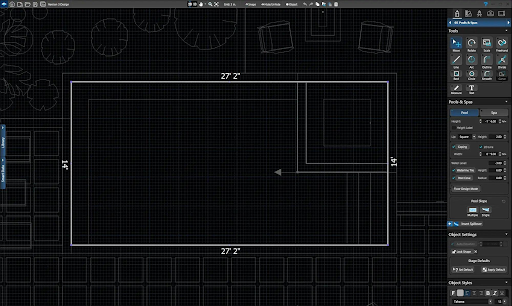
Professional pool design software gives you a measured model of the pool and the property it sits on, so the details an AI image leaves out get real numbers.
|
Workflow Need |
What to Look For |
How Pool Studio Addresses It |
|
Starting on the real site |
Parcel lines and setbacks at scale |
GIS data, bought per address, so you start with the client's parcel, setbacks, and aerial imagery in the file |
|
A pool you can edit |
Changes that keep the rest of the design |
Design in 2D and 3D in the same project, switching views in one click without rebuilding anything |
|
Real pool features |
Spas, water features, and shells |
A pool asset library with water features, spas, and fiberglass shells |
|
Accurate volume |
Calculations from the actual shape |
Smart Data, the panel you use to calculate volume that accounts for steps, benches, cove radius, intersecting spas, and swim-up bars |
|
Your products |
Custom finishes |
Custom materials with your own colors, finishes, and imported graphics files |
|
The client presentation |
Views the client can keep |
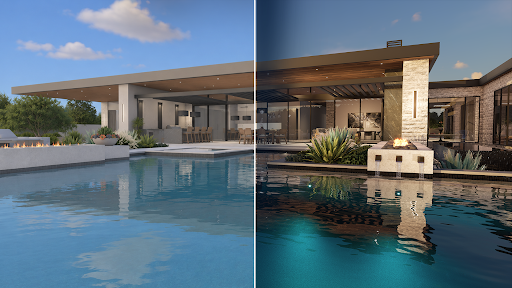
Photos up to 8K, an integrated video storyboard, and day to dusk to night |
|
The build |
Plans from the same file |
Build-ready construction plans from the same project as the presentation |
With Smart Data, you calculate pool volume from the pool's actual 3D shape. The old formula (length times width times average depth) misses steps and benches, and our Smart Data guidance explains the difference.
Those numbers follow your settings, such as concrete thickness, so set them to match how the pool will be built and compare them with material use on recent jobs.
Speed still matters once the model is measured. Pool Studio is built to let you finish in about a day what takes roughly five days in software like SketchUp.
Pool Studio covers all seven needs in one program (from the parcel to the build-ready construction plans), and more than 2 million projects were designed in Structure Studios software in 2025 alone. Whether it fits you depends on how you work.
Configurator apps sit in between.
VirtualPools, for example, lets you combine real products from pool manufacturers into a design on site, which suits builders who work from one product line.
Jeromey Naugle of Premier Paradise Inc described the difference in his Member testimonial: “Pool Studio allows you to do so much and go into so much detail that the client feels like they are in their own backyard instead of just looking at a picture.”
How to use a client's AI image in your process
Treat the image as a brief. Ask the client what drew them to it, and write down their answers in their own words, like the dark water or the stone wall behind the spa.
Pick the details the design has to keep and the one thing the site forces you to change. Then design the pool on their lot at real dimensions, with those details in it.
With the pool in place, keep designing in 3D. Try finishes and lighting against their image, and adjust the terrain and planting around the water until the whole space matches what they pictured.
When you present, show the measured design from the same angle as their image. The client can see that what they liked made it into the design, and that it now fits their property.
FAQs about AI pool design apps and pool design software
Can AI design a pool?
AI apps can picture a pool in a property photo, which helps with style ideas, but they can't design one. The design rests on your site visit and on what the client wants, and we at Structure Studios build Pool Studio to support both with a measured model.
Are AI pool design apps accurate?
They capture a mood well, but nothing in the image is measured. A client can fall for a pool that won't fit their property, so showing them a measured design early keeps what they imagine in line with what can be built.
What is the best pool design software for professionals?
It depends on the work you take on. For custom pools, look for measured 2D and 3D in one file, pool-specific features, accurate volume, and build-ready construction plans.
Configurators suit builders who work from one product line, and general modeling programs such as SketchUp suit designers who want open-ended control. Pool Studio offers all four in one program, with live training included in every Pool Studio Membership.
How much does pool design software cost?
Pool Studio is $147 a month per designer, or $125 a month billed annually ($1,500 a year), with a one-time $95 setup fee (2026 pricing). Pool Studio Memberships include unlimited projects, updates, support, and live training; our pricing comparison lists every tier.
When you compare options, count the whole cost: the software, a Windows computer that meets our system requirements, training, and the time it takes to get up to speed.
We recommend Windows 11, a 10th-generation Intel Core i7 or newer, 16GB of RAM, and an Nvidia RTX 4060 or better; that setup keeps 3D smooth as you design. Our team can help you pick a machine for your workload.
Is there free pool design software?
Yes, though most free tools are basic 2D apps, photo overlays, or AI image generators. Pool Studio offers a free 30-day trial with no credit card, so you can design a full project before deciding.
If you get stuck during the trial, our team of dedicated support specialists is always just a call or message away.
Who uses professional pool design software?
Pool designers, pool builders, landscape designers, and design-build firms use it for the whole job: designing the pool and the space around it, presenting it to clients, and producing the plans to build it.
We build Pool Studio for pool, landscape, and outdoor living professionals who design custom work. It has everything VizTerra offers, plus custom pools, spas, water features, and ponds.
Use the AI image as the start of the design
An AI image is the client showing you the pool they want, and your design gives it real measurements and a plan that whoever builds it can follow.
Next time a client brings one, save it in the project folder and design toward it.
Start your free 30-day trial of Pool Studio and design your next client's pool at real dimensions, starting from the image they bring you. No credit card required.