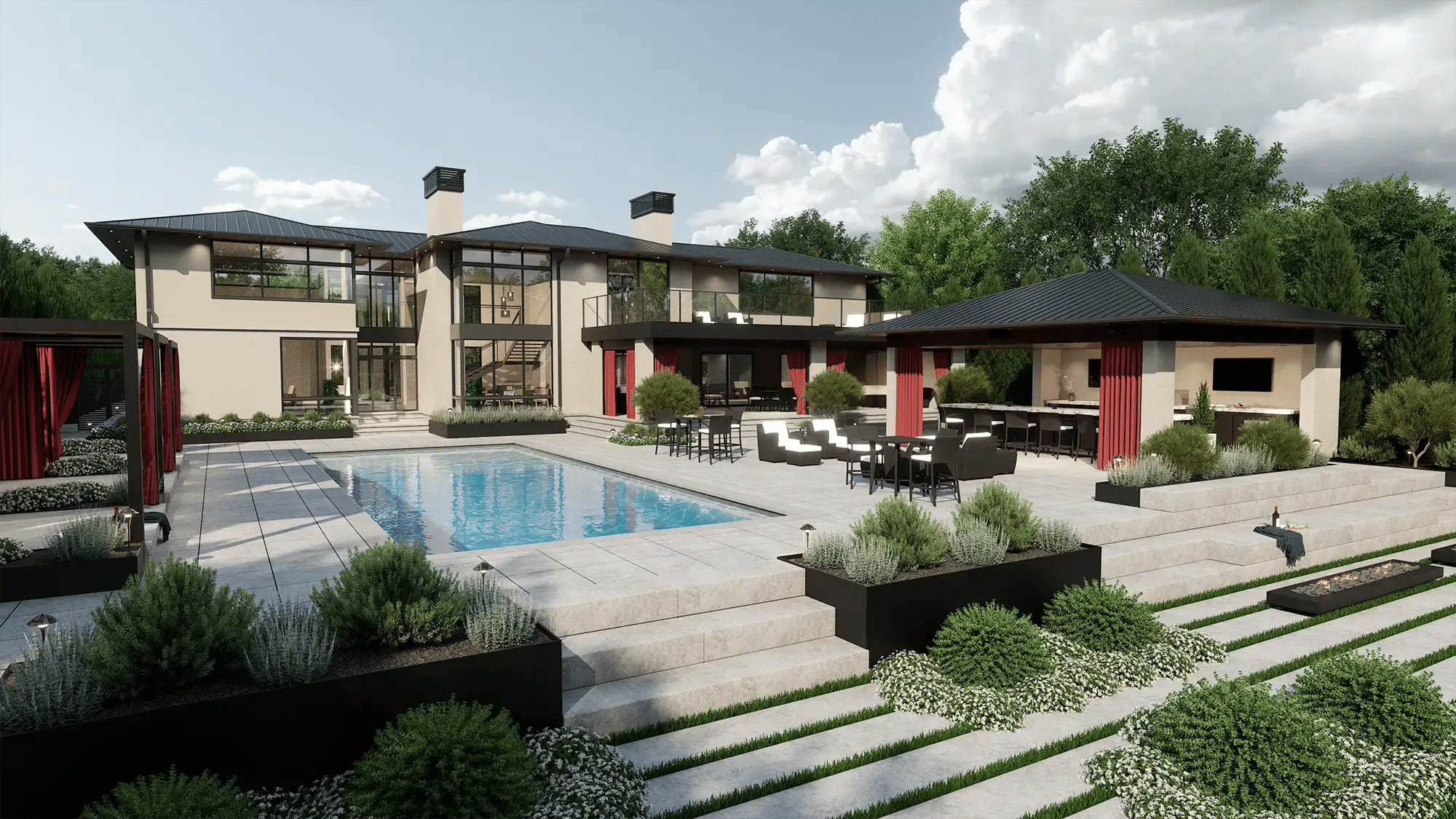




Planning a paver patio, walkway, or pool deck? Use this free paver calculator to estimate paver coverage, aggregate base, bedding sand, joint sand, and edging from your project measurements. Add product details when you want quantities in individual pavers, bags, or pallets.
Key Takeaways
- Paver coverage with allowance = finished area multiplied by (1 + cutting allowance divided by 100).
- Base and bedding volume in cubic yards = area in square feet multiplied by depth in inches, divided by 324.
- Aggregate base uses the extended base footprint. Bedding uses the paved footprint.
- Bedding sand goes under the pavers, and joint sand goes between them, and their coverage figures are unrelated.
- Compacted volume and delivered loose volume are different measures, so ask the supplier for the conversion.
Calculate your paver materials
Start with your patio or walkway area. Add product details when you have them to build your materials list.
Loading the calculator. The formulas and worked example below are available without the interactive tool.
Your materials estimate
Inputs and assumptions
For contractors preparing a materials list, the useful number is what the project needs and how that translates into an order. The calculator separates measured quantities, your selected allowances, and whole-package rounding so you can see where each number comes from.
This free tool is from Structure Studios, makers of VizTerra landscape design software.
How To Use The Paver Calculator
- Enter your project area. Use length and width, a circle diameter, or an area you have already measured. Add up to five non-overlapping sections when they use the same material and installation details.
- Set your cutting allowance and layer depths. Enter the planned compacted base depth and screeded bedding depth from your project requirements. Missing layer information can be added after getting an area-based paver estimate.
- Add product details if you have them. Package coverage, installed coverage per paver, joint-sand coverage, and exposed edging length help turn the estimate into purchasing units.
- Review and save the list. Check the assumptions, fill in any missing supplier details, then copy, print, or share the calculation.
You can use U.S. or metric measurements. Keep the units consistent with the quantities your supplier sells, especially for layer depths and bulk materials.
This is a preliminary materials estimate for conventional sand-set pavers. Use your project design and product instructions to choose the installation layers. Base requirements depend on factors including soil, drainage, climate, and loading, all of which the CMHA application guidance for segmental pavements covers in detail.
What Your Paver Materials List Means
| Material | What the quantity tells you |
|---|---|
| Pavers | The finished area to cover, followed by coverage with your cutting allowance. Product details can convert it to pieces or packages. |
| Aggregate base | The compacted volume under the selected footprint. The initial setting excludes base extension. Choose an all-side extension for one rectangle or circle, or enter the actual combined base area. A loose delivery quantity needs your supplier's extra-volume allowance. |
| Bedding sand | The geometric volume beneath the paved area at your specified screeded depth, before purchasing adjustments. Finished bedding thickness is a separate optional input. |
| Joint or polymeric sand | The bags needed using the selected product's coverage for your pavers and joints. |
| Edge restraint | The measured exposed length that needs new restraint, with optional rounding to stock lengths. Section counts assume usable offcuts and do not plan corners or fasteners. |
| Geotextile, when included | Your entered fabric coverage with the percentage you specify for overlaps and cuts; this does not produce a roll-cut layout. |
Pallet and bag counts depend on the products you intend to buy. If those details are missing, use the calculated area or volume as the starting point for a supplier conversation.
Worked Example: A 20 × 15 Ft Paver Patio
Suppose you are estimating a rectangular patio that is 20 feet long and 15 feet wide. Its finished area is 300 square feet.
For this example, you enter a 10% paver cutting allowance, a 4-inch compacted base, a 6-inch base extension on all four sides, and a 1-inch screeded bedding layer. These are illustrative inputs, not installation recommendations for every site.
| Item | Calculation | Quantity |
|---|---|---|
| Finished patio | 20 × 15 | 300 sq ft |
| Pavers with 10% allowance | 300 × 1.10 | 330 sq ft |
| Pavers sold in 100 sq ft packages | Round 330 ÷ 100 up to whole packages | 4 packages, covering 400 sq ft |
| Extended base area | 21 × 16 | 336 sq ft |
| Compacted aggregate base | 336 × 4 ÷ 324 | About 4.15 cu yd |
| Bedding sand before ordering adjustments | 300 × 1 ÷ 324 | About 0.93 cu yd |
If the supplier specifies 25% extra loose base volume and sells in quarter-yard increments, the loose requirement is approximately 5.19 cubic yards and the order rounds up to 5.25 cubic yards. The calculation uses the full-precision quantities before rounding.
The paver order also illustrates why allowance and packaging need separate lines: 330 square feet is the allowance-adjusted requirement, while 400 square feet is what four full packages provide.
How To Calculate Pavers, Base, And Sand
For a rectangle, multiply length by width to find area. For a circle, multiply π by the radius squared. If you already know the area of an irregular project, enter that measurement directly.
For pavers, start with:
Paver coverage including allowance = finished area × (1 + cutting allowance ÷ 100).
Then divide by the manufacturer's coverage per package and round up to a whole package. For an individual-piece estimate, divide by the installed coverage per paver. Custom paver dimensions provide a geometric estimate; actual dimensions and joints can change coverage. Manufacturer data is the better purchasing reference. Example manufacturer coverage data
For base or bedding in U.S. units:
Cubic yards = area in square feet × depth in inches ÷ 324.
In metric units, multiply square meters by depth in meters to get cubic meters. Divide millimeters by 1,000 before multiplying.
Use the extended base footprint for aggregate and the paved footprint for bedding. Do not automatically add the paver cutting allowance to either one. Each material needs the allowance relevant to that material.
Before You Order: Five Details To Check
- Confirm product coverage. A nominal paver size or a generic pallet count may differ from your chosen product.
- Separate compacted and loose quantities. The installed base volume and delivered loose volume are different measures. Ask the supplier for the appropriate conversion.
- Check the exposed edges. An area measurement cannot determine perimeter. Joined sections and existing edges need separate attention.
- Keep bedding and joint sand separate. Bedding goes below the pavers; joint sand fills the spaces between them. Polymeric-sand coverage varies with the product, pavers, and joints. Manufacturer coverage guidance
- Read the allowance before rounding. Cutting allowance, handling allowance, and whole-package rounding solve different problems. Apply each one once.
Ask your supplier for package coverage, applicable sand-bag coverage, delivery units, and order increments. That information makes the materials list easier to use when placing the order.
Paver Calculator FAQs
How Many Pavers Do I Need For A 300-Square-Foot Patio?
It depends on the product's installed coverage. If each paver covers 1 square foot, a 300-square-foot patio needs 300 pavers before cutting allowance. A selected 10% allowance raises that to 330 pieces. If the product is sold only in full packages, package rounding may increase the purchase again.
How Much Extra Should I Allow For Cuts?
Use an allowance appropriate to the pattern, perimeter, cuts, and product. A rectangular layout and a curved patio can create different cutting needs. The calculator lets you enter that allowance; the 10% used in the worked example is an illustration, not a guarantee that every project needs the same amount.
How Many Square Feet Are On A Pallet Of Pavers?
Use the coverage listed for the exact product and package. Paver sizes and mixed-size sets vary, so a generic pallet figure can produce the wrong order. Enter the supplier's coverage to calculate whole packages.
How Many Bags Of Polymeric Sand Do I Need?
Divide the installed paved area by the applicable coverage per bag and round up. For example, 300 square feet divided by a product coverage of 75 square feet per bag is four bags. Confirm that the coverage applies to your paver dimensions and joints.
Can I Calculate Materials For An Irregular Patio?
Yes, if you have a measured area, or can divide the project into supported, non-overlapping sections. Enter the actual exposed perimeter and base area when needed. Adding the outlines of adjoining rectangles can count shared edges twice.
Does The Calculator Estimate Installed Patio Cost?
It estimates material quantities. Labor, equipment, delivery, disposal, taxes, and supplier pricing need to be added separately when preparing a project price.
Related Calculators
Working out a different number on the same project? Use our Landscape Grading Calculator for slope and cut and fill, the Landscape Material Calculator for soil, mulch, and aggregate, and the Pool Gallon Calculator for water volume.
Design The Patio Your Client Wants To Build
A materials list helps you plan the order. A clear design helps your client understand the patio: where people will sit, how a walkway connects, and how the space works with planting beds or an outdoor kitchen.
With VizTerra landscape design software, you can develop the layout in 2D, explore it in 3D, and present the outdoor space to your client. Measurements and construction plans stay connected to the design project.
For a closer look at that workflow, see how to visualize an outdoor design in 3D.
Show your client the finished patio before construction starts. Check our pricing and feature comparison to choose the right plan, or start your free trial today.
Explore VizTerraStart Your Free Trial
The Structure Studios free trial includes VizTerra. No credit card required.