
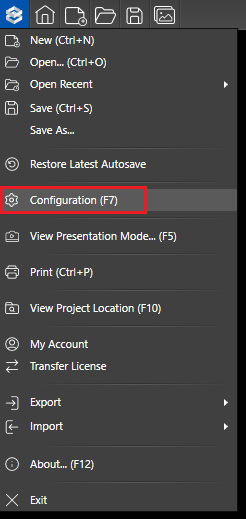
 Opening the Configuration Menu: You can access the configuration menu by going to the Application Button menu and selecting Configuration or by pressing F7 on your keyboard.
The different controls and settings are divided into 9 Tabs.
General Tab
The General Tab allows you to control how library items appear, your color theme, and general settings.
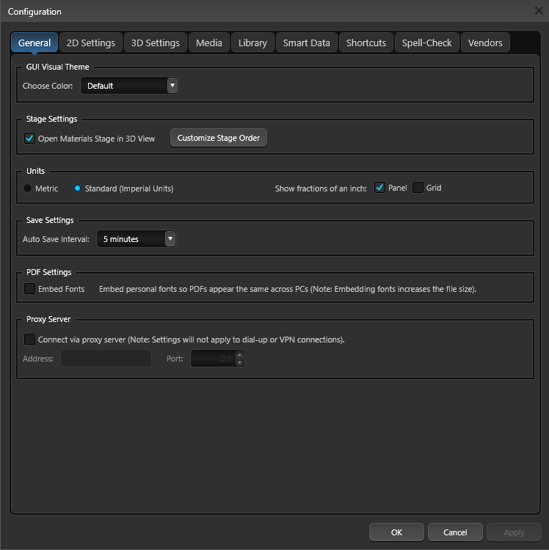
GUI Visual Theme: This control allows you to change the overall color theme of the software.
Open Materials Stage in 3D View: When this option is enabled, the software will automatically switch to 3D view each time you enter the Materials Stage.
Customize Stage Order: This control allows you to change the order in which the stages appear. Press Reset Stage Order to revert to the default stage order.
Units: This setting controls which measurement units are used while you design. You can switch between Standard/Imperial (feet and inches) and Metric, and all measurements in the project—including existing shapes—will update immediately.
Show Fractions of an Inch: When this option is enabled, all height fields in the Panel and on the grid display values with two decimal places.
Auto Save Interval: By default, the software automatically saves each project at 5-, 10-, and 15-minute intervals. You can adjust this interval in the dropdown.
To open autosaved files, first open the project, then press F10 to open its folder in File Explorer. Open the “Autosaves” subfolder and load the files there to restore an earlier version of your design.
PDF Settings: When this option is enabled, your chosen fonts are embedded in the exported PDF so it appears the same on any device. If the box is unchecked, a red “F” icon will appear next to fonts that will not be included in the PDF.
Proxy Server: When this option is enabled, the software connects to the internet using the specified proxy server.
2D Settings Tab
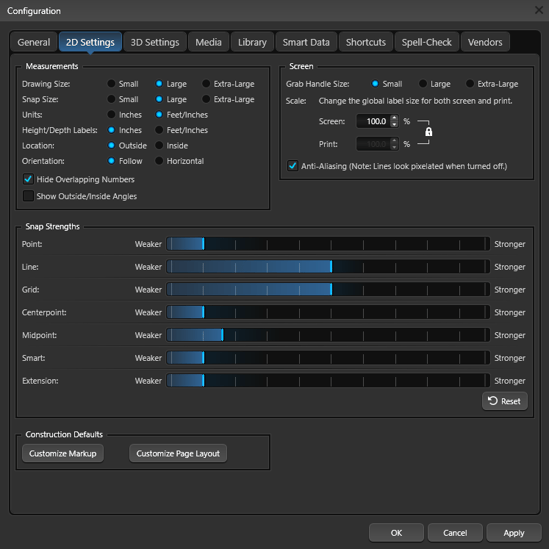
The 2D Settings Tab allows you to set the font measurement size, snaps and constraints strength and change the scale of the labels in the program.
Measurements
Use these controls to set the font size for your drawing and smart snap measurements, and to adjust the overall scale of labels so they appear at the desired size on screen.
Drawing Size: This control allows you to select the font size of your drawing measurements. You may select Small, Large or Extra Large.
Snap Size: This control allows you to select the font size of your smart snap measurements. You may select Small, Medium or Large.
Units: This control allows you to display linear measurements in 2D as either inches only, or feet and inches.
Height/Depth Labels: This control allows you to display height/depth label measurements in 2D as either inches only, or feet and inches.
Location: This control allows you to display your measurements on the outside or inside of the line.
Orientation: This control allows the measurement orientation to display following the line or horizontally.
Hide Overlapping Numbers: With this box checked, any shape measurements that overlap will be automatically hidden. This creates a cleaner design. Uncheck this box, to show all measurements.
Show Outside/Inside Angles: When this option is checked, both the inside and outside angles of each segment are displayed as you draw.
Snaps Strengths
These sliders allow you to adjust the strength of your snaps. The higher the pixel number, the stronger the snap will be. The pixel number represents the number of pixels away your cursor needs to be in order for the snap to take effect. Press the Reset button to restore the default strengths.
Screen
Grab Handle Size: This control allows you to select the size of your drawing grab handles.
Scale: This lock icon will lock the print scale to the screen scale. Uncheck it to set a different print scale. Note: We do not recommend changing these settings from 100%.
Anti-Aliasing: With this box checked, lines in the software will look clean and smooth. With the box unchecked, lines in the software will look jagged and pixelated if not at perfect 0, 90, or 180 degree angles.
Construction Defaults
Customize Markup: This option opens your default Construction Markup layer settings.
Customize Page Layout: This option will open your default page settings when you enter Construction Page Layout.
3D Settings Tab
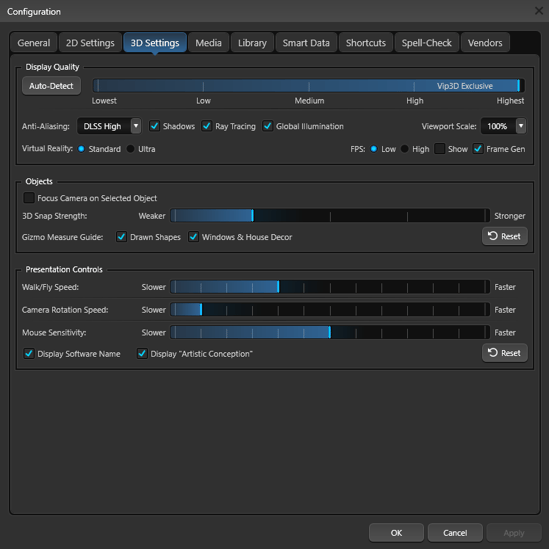
The 3D Settings Tab allows you to control the appearance and quality of the Presentation Mode.
NOTE: These features are completely dependent on your computer’s hardware.
Display Quality
Display: Auto-Detect automatically applies the optimal display settings for your computer.
This slider controls overall visual quality in Presentation Mode. Higher settings increase detail and realism, while lower settings reduce detail but improve performance and frame rate.
Anti-Aliasing: This setting smooths jagged edges in 3D to produce a cleaner, softer image. Choose from DLSS Low, Medium, or High (RTX cards only), Temporal, or None.
Shadows: This setting lets you enable or disable real-time shadows in 3D.
Ray Tracing (Only available on RTX cards): This setting increases the realism of your scene, producing more immersive designs with significantly more natural-looking shadows and reflections. For more information, see Ray Tracing.
TIP: Ensure Anti-Aliasing DLSS is ON when using Ray Tracing.
Global Illumination (Only available when Ray Tracing is Enabled): This setting increases the realism of your scene, producing more immersive designs with significantly more natural-looking shadows and reflections.
Viewport Scale: This dropdown will allow you to adjust the resolution of the Viewport Scale. Set this resolution the same as your monitor’s resolution.
Virtual Reality: This setting lets you control VR quality. Use Standard for the most responsive experience, or switch to Ultra for the most immersive visuals.
FPS: This setting displays your current frames per second (FPS) and lets you limit performance between a Low cap of up to 60 FPS and a High cap of up to 120 FPS.
Frame Gen: This setting enables AI Frame Interpolation. It is only available on systems with a NVIDIA RTX 4070 or higher.
Objects
Focus Camera on Selected Object: This feature allows you to prevent the camera from adjusting its focus automatically when you select an object. This gives you fine control over the behavior of the camera, allowing you to focus on specific areas or objects without any camera movement.
3D Snap Strength: This slider allows you to adjust the strength of the snap when placing objects that snap in 3D, such as windows, doors and pool lights. The higher the strength, the greater distance away an object will snap to the design shape.
Gizmo Measure Guide: These precise distance guides provide clear, easy-to-follow measurements to the edge of drawn shapes and windows/house decor, ensuring that you can position your objects with accuracy.
Presentation Controls
Walk/Fly Speed: This slider allows you to adjust the speed at which you move while in walk or fly mode.
Camera Rotation Speed: This slider allows you to adjust the speed at which the automated tour rotates.
Mouse Sensitivity: This slider allows you to adjust how sensitive the mouse is to your movements.
Display Software Name: Check this box for the Software Name to appear in the top right corner of Presentation Mode, Video Mode and Photo Mode.
Display Artistic Conception: Check this box for Artistic Conception to appear in the top left corner of Presentation Mode, Video Mode and Photo Mode.
Media Tab
The Media Tab allows you to set preferences for screenshots and video recording.
For more information, see Photo Mode and Video Mode.
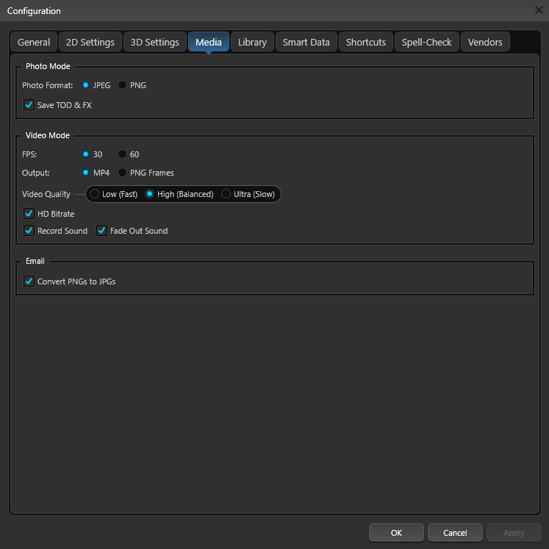
Photo Mode
Photo Format: This control allows you to set the format of your screenshots. You may select JPEG or PNG. PNG will enhance the colors and lighting in your image but PNG files tend to be larger than a JPEG, because they contain more information.
Save TOD & FX: With this box checked, save the time of day and image filter settings unique to each location.
Video Mode
FPS: This setting controls your video frame rate. You can choose 30 FPS (most widely supported) or increase it to 60 FPS for smoother playback.
Output: This control allows you to choose the format in which your video will be saved. The default format is MP4. If you select PNG Frames, it is intended for advanced video creation and allows you to export RAW PNG frames instead of MP4 videos.
Video Quality: This setting controls your video quality. Choose Low (Fast), High (Balanced), or Ultra (Slow). Ultra produces the sharpest videos with improved reflections and shadows, but each render will take significantly longer.
HD Bitrate: With this box checked, create better quality, clearer videos. The video file size will be significantly larger.
Record Sound: With this box checked, all sounds playing in the software will record with the video. You can use this feature to play music during the Presentation.
To learn how to Insert Music, see Sound Effects. Uncheck this box to record silent videos.
Fade Out Sound: With this box checked, the sound will gradually decrease at the end of the video.
Convert PNGs to JPGs: With this box checked, your photos will be automatically sent via email in JPG format.
Library Tab
The Library Tab allows you to control how library items appear, new item notifications, and plant naming.
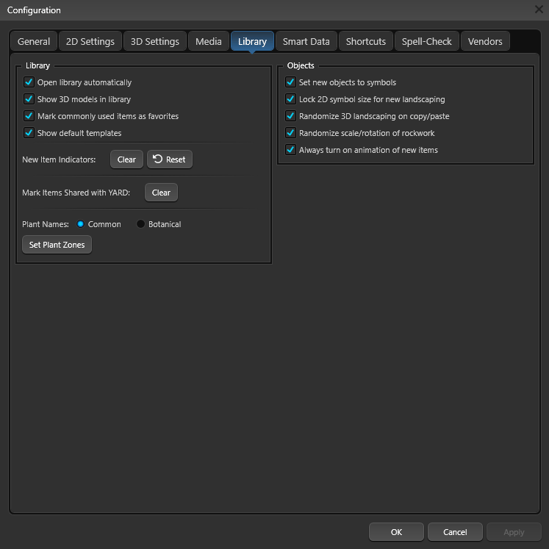
Library
Open Library Automatically: Check this box to cause the library to automatically expand when going to a stage that requires the library. This would include Materials and Plants and Items.
Show 3D Models in Library: Check this box to display all items in the library as 3D models. Uncheck this option, to show items as 2D symbols instead.
Mark Commonly Used Items as Favorites: Check this box to automatically add the items you use the most to your Favorites tab of the Library. Once an item is inserted 25 times, a blue star will appear in the item preview thumbnail. Uncheck the blue star to remove the item from your auto favorites.
Show Default Templates: Check this box to include the default templates included in the software in your Design Library.
New Item Indicators: Press the Clear button to remove the New Item exclamation points in the Library. Press the Reset button to restore the New Item list from the most recent update.
Mark Items Shared with YARD: Press the Clear button to remove the YARD points in the Library.
Objects
Set New Objects to Symbols: Check this box to have new plants and trees insert as 2D symbols. Uncheck the box to have new plants and trees insert as 3D markers.
Plants and trees that have already been inserted can be changed by selecting them and using the Show Landscaping as Symbols button located in the Panel.
Lock 2D Symbol Size for New Landscaping: Check this box to ensure that new plants and trees are inserted with a locked 2D symbol size. This will result in clean and uniform landscaping plans. If you uncheck the box, the plants and trees will match the size in 3D.
Randomize 3D Landscaping on Copy/Paste: Check this box to automatically randomize the rotation and scale of the Plants & Trees you add with copy/paste or Shift-drag. Each time you paste or Shift-drag a plant, it will have a slight change to rotation and size than the original.
Randomize Scale/Rotation of Rockwork: Check this box to automatically randomize the rotation and scale of the rockwork that you insert. Each time you insert a rock, it will have a different rotation and appearance than the previously inserted rock.
Always Turn On Animation of New Items: Check this box to default animations on for animated items inserted from the library such as animals and ceiling fans. Uncheck this box to default animations off.
Animations for items you have already inserted may be turned on/off by using the Play/Pause button located in the Panel.
Plants & Trees
Plant Names: Landscaping may be listed by either common or botanical names.
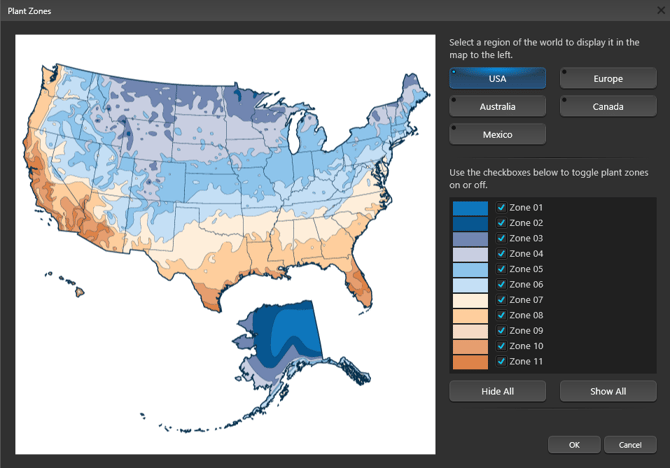
Set Plant Zones: This button allows you to select which plant zones appear in the library. Press the button to open the Plant Zones Map.
First select a region of the world to display on the map. Next use the checkboxes to select which plant zones appear in the library.
Smart Data Tab
The Smart Data Tab allows you to customize how data is calculated and appears in Smart Data. Adjust concrete thickness, rebar settings and how measurements are displayed.
For more information, see Smart Data.
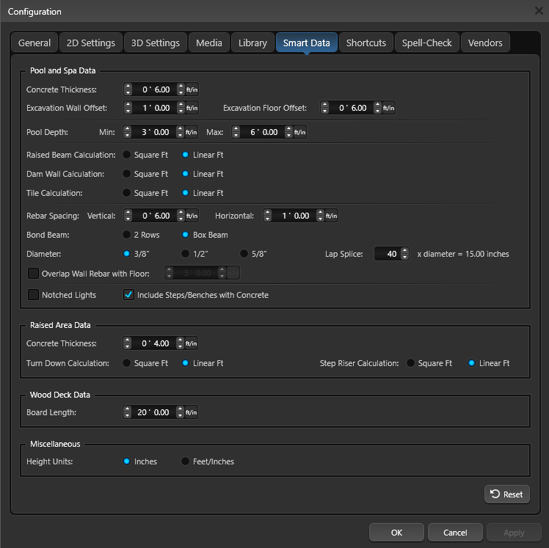
Pool and Spa Data
Concrete Thickness: This control will allow you to select a concrete thickness for your Pool and Spa shapes.
Excavation Wall Offset: This control will allow you to set a wall offset for your Pool and Spa shapes.This value increase the size of the hole that is used for pool and spa excavation calculations.
Excavation Floor Offset: This control will allow you to set a floor offset for your Pool and Spa shapes. This value increases the size of the hole that is used for pool and spa excavation calculations.
Pool Depth: This control will allow you to set your default minimum and maximum depth for each new pool shape.
Raised Beam Calculation: Raised Beam may be listed by either square ft. of material or linear ft. of the face.
Dam Wall Calculation: Dam Wall may be listed by either square ft. of material or linear ft. of the face.
Tile Calculation: Tile may be listed by either square ft. of material or linear ft.
Rebar Spacing: This control will allow you to set your vertical and horizontal rebar spacing.
Bond Beam: Bond Beam may be 2 rows or box beam (4 rows) of rebar around the Bond Beam of the Pool or Spa.
Diameter: Rebar diameter may be listed as 3/8″ 1/2″ or 5/8″
Lap Splice: This control will allow you to set your lap splice. Default is a Lap Splice of 40x the diameter of the rebar (40 x 3/8″)
Overlap wall Rebar with Floor: With this box checked, the wall rebar with overlap with the floor rebar. Default is an overlap of 3 feet. Use this control to set the amount of overlap.
Notched Lights: With this box checked, the lights will be notched, adding 1 yard of concrete and 20′ of rebar for each pool or spa light.
Include Steps/Benches with Concrete: With this box checked, the concrete calculation with include Steps and Benches, using the concrete thickness uniformly for all shapes. When unchecked, Steps and Benches will not be included in the Concrete calculation.
Raised Area Data
Concrete Thickness: This control will allow you to select a concrete thickness and will directly affect your deck/hardscape concrete yardage calculation.
Turn Down Calculation: Turn down may be listed by either square ft. of material or linear ft. of the face.
Step Riser Calculation: Step risers may be listed by either square ft. of material or linear ft. of the face.
Wood Deck Data
Board Length: This control will allow you to set your board length for wooden decks.
Miscellaneous
Height Units: Height values may be listed by either inches or feet and inches.
Reset: Press Reset to revert to the default settings.
Shortcuts Tab
The Shortcuts Tab allows you to reassign keyboard commands.
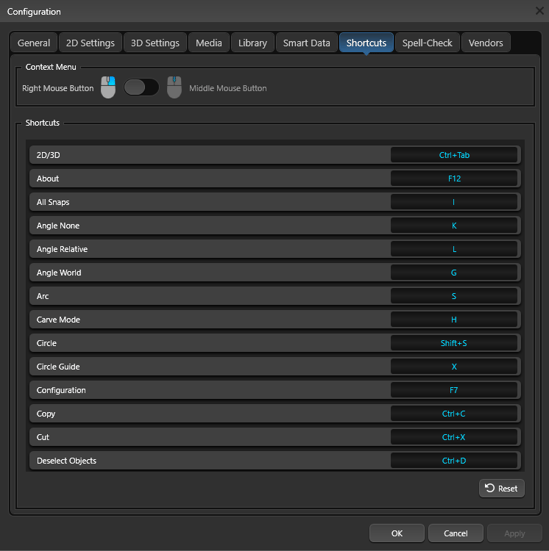
Context Menu
The context menu can be linked to your right mouse button or middle mouse button.
Shortcuts
To change the shortcut command, click on the currently assigned command.
Three question marks will appear, asking what new keyboard command to use. You can use a single button, such as a letter or number, or combination of CTRL, SHIFT and a letter/number.
If the new value is already being used by another command, the software will alert you that the two commands will be swapped.
Spell-Check Tab
As you type, the software will alert you to any potential typos and spelling errors. Simply right click on the word to see recommended replacements, choose to ignore the word, or add it to your dictionary.
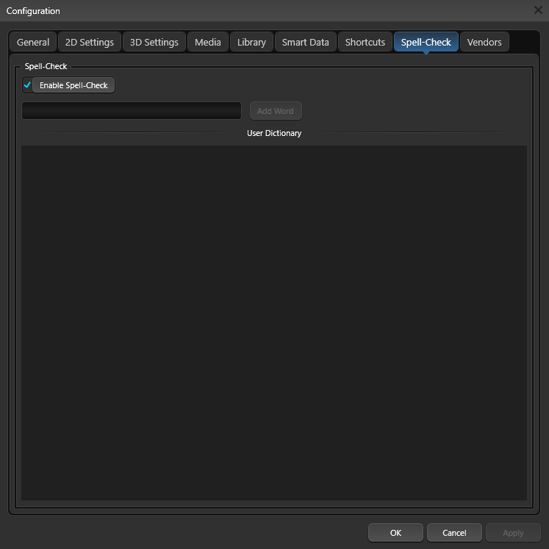
Enable Spell-Check: With this box checked, the software will alert you to any potential spelling errors.
Add Word: It’s easy to add any industry-or company-specific terms to build your own custom dictionary.
Vendors Tab
The Vendors Tab allows you to control which vendor packages appear in your library. You can turn off vendors you don’t use to clear the items out of the library.
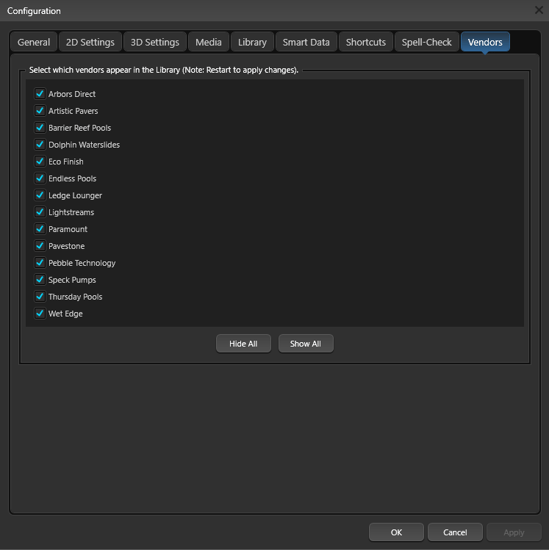
Vendors: All vendor packages currently available will appear in this list. To turn ON a vendor package simply place a checkmark next to the vendor.
To turn OFF a vendor package simply remove the checkmark next to the vendor.
NOTE: You must restart the software for these changes to take effect.